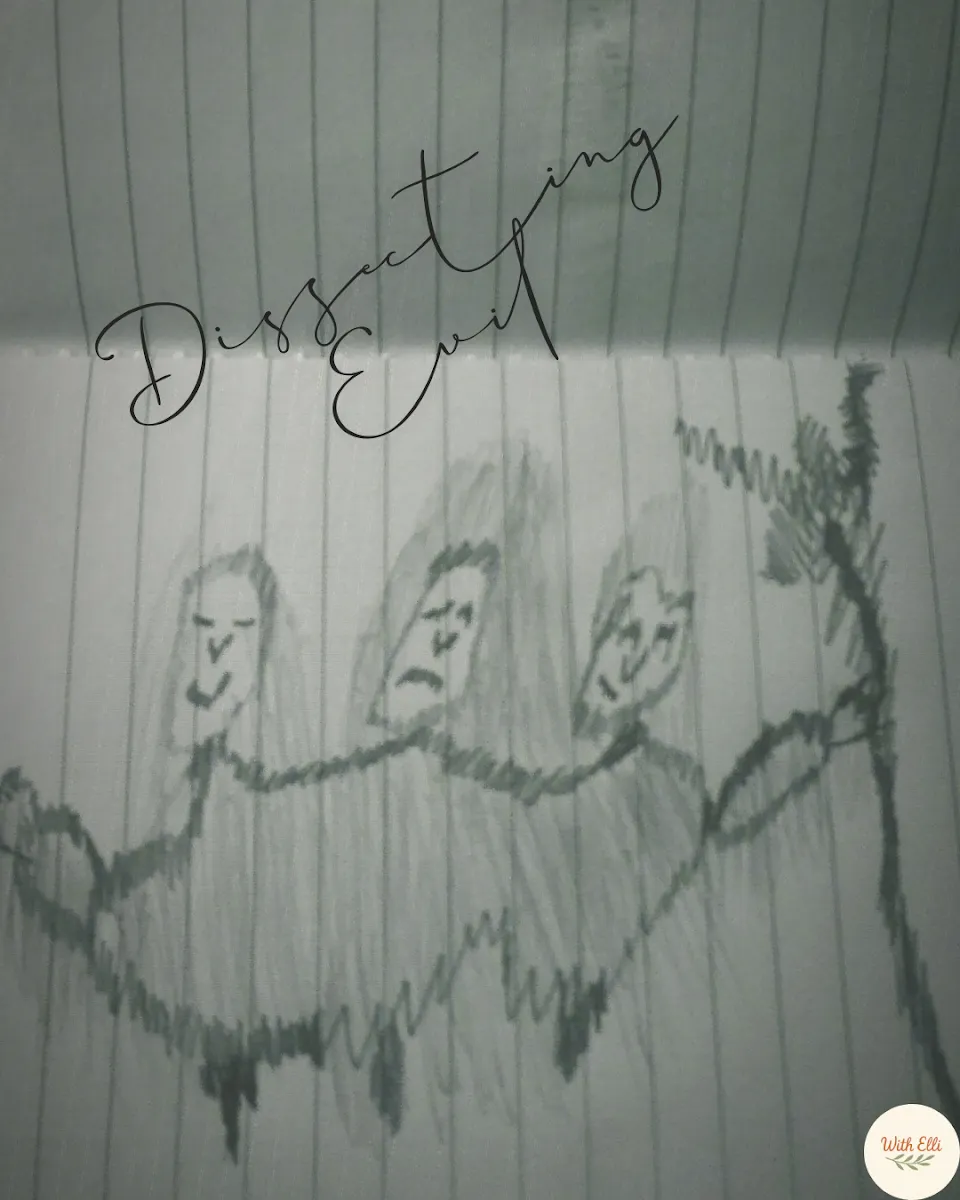
Evil is a mythical creation something we invented so we can more simply understand behaviors that we cannot otherwise explain. At its core, it comes down to two things: the lack of empathy and the gathering of power.
I read about the Nazis in the past. I wasn't impressed with what I found not because it wasn't horrifying, but because I had already seen it before. In Balkan history, Ottoman history, Greek history, European history. I am sure in many other histories too. But what makes World War II unique is its propaganda and media coverage. We don't only read about it we see it on a screen. The barbaric war tactics, the choices of winners and losers, all of it documented, broadcast, analyzed.
Did we understand the lessons of World War II?
I'm not even asking about World War I, because I'm sure that today fewer people in Europe know who was involved in it and why. So I'll ask only about the second one.
What did we learn? Do you see history repeating itself?
How is that even possible? Books were written. People discussed. Entire generations tried to understand all that "evil." And now it is repeating sometimes from the very allies, the very victims of those atrocities.
What Is "Evil," Really?
The word "evil" is ancient. Across cultures and centuries, it has served as a container for what humans cannot easily categorize or accept: cruelty, indifference, destruction. Mythologies gave evil a face a god, a demon, a serpent because the alternative, that ordinary humans are capable of extraordinary harm, is far more unsettling.
Hannah Arendt, who covered the trial of Nazi war criminal Adolf Eichmann in Jerusalem, introduced the concept of the "banality of evil." Eichmann wasn't a monster in the theatrical sense. He was a bureaucrat. A man who followed orders, processed paperwork, and never looked directly at the consequences. Her observation shook the world: evil doesn't always announce itself. It often wears a uniform and fills out forms.
This is what I keep coming back to. We created the myth of "the evil ones" precisely so we wouldn't have to look at ourselves.
The Pattern
What is being noticed in my writing and what historians and scholars confirm is that the patterns of mass violence are not unique to Nazi Germany. Dehumanization, propaganda, scapegoating, the concentration of power. They appear in Ottoman history, in the Balkans, in colonial Africa, in Cambodia, in Rwanda, in Bosnia.
The machinery of atrocity tends to follow recognizable steps. Gregory Stanton, founder of Genocide Watch, identified what he calls the Ten Stages of Genocide a framework that includes classification, symbolization, discrimination, dehumanization, organization, polarization, and ultimately extermination. The terrifying thing is not that these stages are obscure. It is that they are visible and that people still miss them, or choose to look away.
What Did We Actually Learn?
The honest answer is: institutionally, quite a lot. Individually, not enough.
After World War II, the world built structures meant to prevent repetition:
- The Nuremberg Trials established that "following orders" is not a legal defense for crimes against humanity.
- The Universal Declaration of Human Rights (1948) enshrined protections for every human being regardless of nationality or identity.
- The Geneva Conventions were expanded and strengthened.
- The concept of genocide was legally defined largely due to the relentless work of Raphael Lemkin, a Polish-Jewish lawyer who lost 49 family members in the Holocaust.
These are real achievements. They matter. But institutions only hold as long as the people within them believe in what they represent.
Why Is It Repeating?
This is perhaps the hardest question. And the one I can't stop thinking about because it is not strangers repeating the patterns. It is often the former victims, the former allies, the inheritors of the grief.
There are a few uncomfortable truths worth sitting with:
1. Trauma does not automatically produce empathy. Surviving or descending from atrocity does not guarantee that a person or a nation will refuse to inflict it. Unprocessed collective trauma can turn inward, creating a closed circle of "us" and "them" that mirrors the very logic used against the original victims.
2. Propaganda evolves faster than critical thinking. World War II was the first war fully covered by media. We saw it on screens. But today's media environment is incomparably more complex, more fragmented, more susceptible to manipulation. Dehumanizing language spreads faster than context. Outrage travels faster than truth.
3. Power has no ideology only appetite. The gathering of power I see at the root of all of this is not left-wing or right-wing, Eastern or Western, ancient or modern. It is a human tendency that requires active structural resistance checks, balances, free press, civil society, dissent. When those erode, the pattern re-emerges regardless of what flag flies overhead.
4. We remember the horror but forget the warning signs. Holocaust education often focuses, rightly, on the magnitude of the crime. But Stanton's framework reminds us that genocide does not begin with gas chambers. It begins with language with the slow normalization of treating a group of people as less than human. By the time the violence is visible, many of the earlier stages have already been missed.
The Question That Stays
I don't have a clean answer. And I think that's the most honest place to sit with this.
What I can do what I think this kind of writing is for is refuse to look away. To notice the pattern when it appears. To call it what it is before it has a name that history will later add to textbooks.
To remember that "evil" is not a separate species. It is a direction humans can move in, when empathy is slowly dismantled and power is left unchecked.
And to keep asking these questions even when, especially when, the answers are uncomfortable.
With Elli