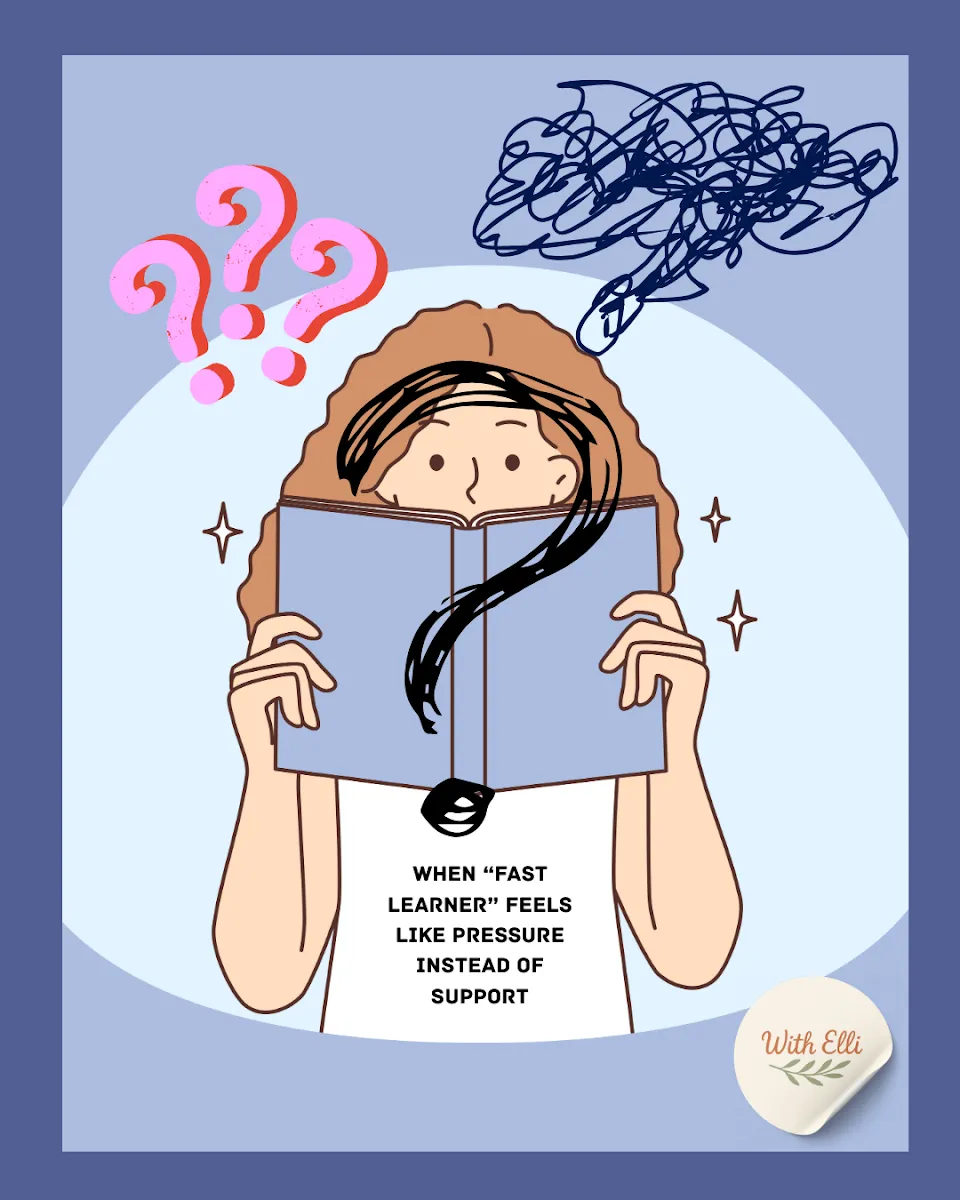
The class was entirely in Dutch. Most of the other students already knew some Dutch, and I felt behind. It was difficult to connect, difficult to make friends, and I felt isolated. I could understand parts of what was being said, but I was not able to form full sentences, and that made everything feel heavier and more exposing.
When I asked to move to a different class, the answer I received was simple and final: based on the test I had taken, I was considered a fast learner, so I couldn’t move to a beginner group.
What I felt in that moment wasn’t pride.
It was pressure.
Pressure to continue because I’m “smart.”
Pressure I’ve carried since childhood.
Growing up, I heard the same phrases again and again: “You’re really smart,” “You have so much potential.” But those words were rarely paired with care. They were often used to push me harder, to perform better, to succeed without anyone asking whether I actually could.
No one asked how my mental health was doing.
No one asked whether I felt safe, supported, or overwhelmed.
No one asked what that pressure was doing to me.
We are not machines. Learning is not only about logic, speed, or facts. Emotional learning matters. Safety matters. Being seen matters.
So I started asking myself again:
What does it really mean when people say I’m a fast learner? How can a test decide that?
My whole life, people told me I had potential. And now, as an adult, I sometimes feel like a failure because I constantly feel I’m not reaching it.
From my family to my teachers, there were always expectations but very little guidance. No one sat down with me to truly listen. No one explained how mental health can affect learning, how stress and anxiety change the way the brain works, or what daily difficulties I might face because of that.
Calling someone brilliant and then labeling them as lazy when they struggle is not constructive criticism. It doesn’t help someone grow. It doesn’t help them become a happy or fulfilled person.
Without guidance on emotional regulation, self-understanding, and inner safety, how is anyone supposed to reach goals that others place on them?
At some point, I realized something important:
Stop showing the road to others. Walk your own path. Share your story. Let people take what they need from it.
Don’t teach from a distance.
Suggest from experience.
This is not a rejection of learning, intelligence, or ambition. It’s an invitation to remember that behind every label fast or slow learner, smart, gifted, stupid, lazy there is a human being with emotions, limits, and a nervous system that needs care.
Learning should not feel like survival.
Growth should not come at the cost of well-being.
And potential should never be a burden.