 |
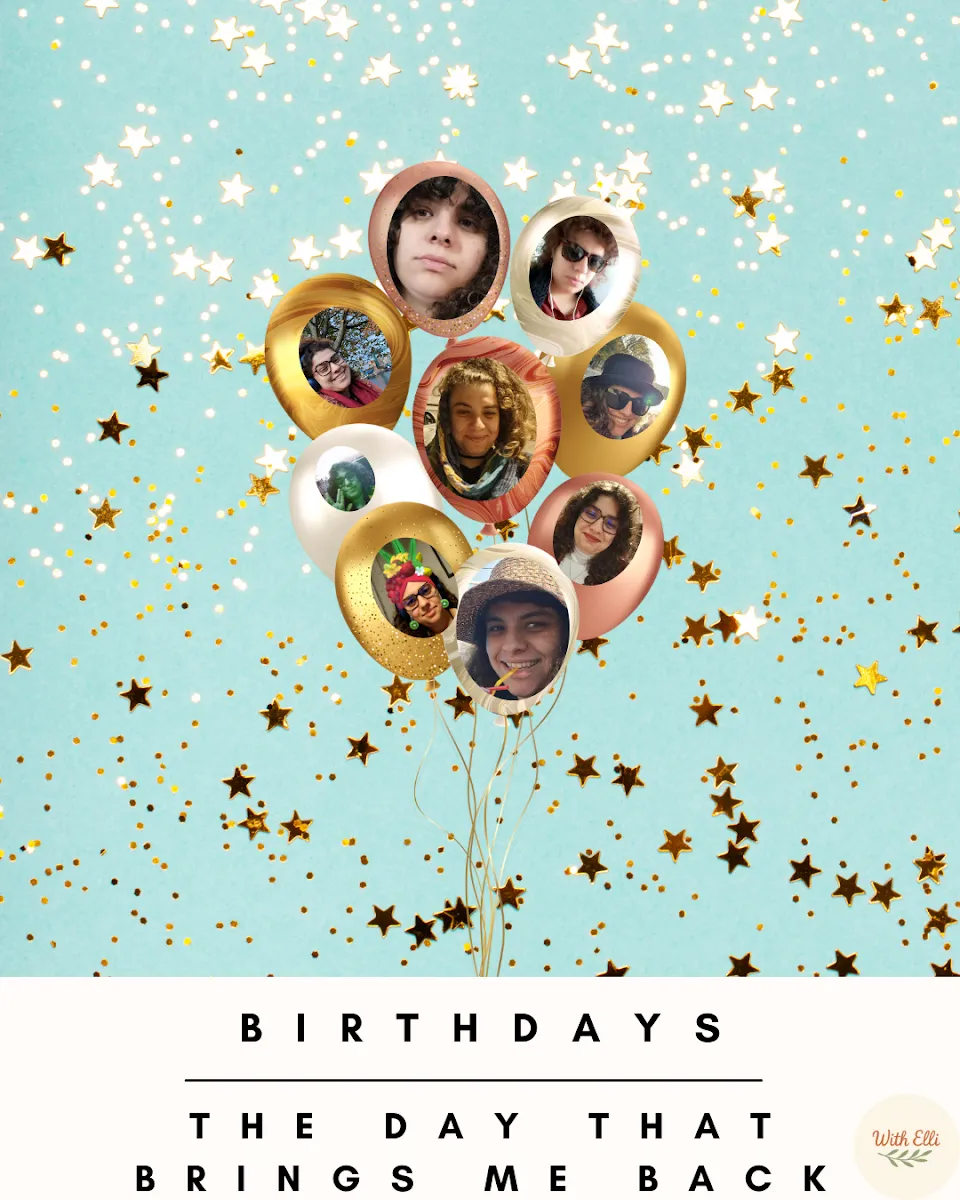
How I feel on my birthday - past vs. present.
Why did I love surprise parties so much? Because it was the one day I had the parents I wanted in my life. One day I felt close to people, felt that people cared about me. But always with a sadness underneath: Do I deserve to be born? Am I enough?
Now those feelings return every year on my birthday. I feel very strongly that young girl I was - waiting and feeling.
Everyone experiences their birthdays differently. That moment in the past that we celebrate every year triggers different things for each of us.
Take good care of yourself on that day. Do things that feel good, feel safe, and celebrate life.
I'm trying to enjoy my birthdays now with the people I love.
Birthdays, Regret, and the Feeling of "Too Late": Research That Might Help You Understand What You're Experiencing
Birthdays can be complicated. For some of us, they're not just celebrations - they're emotional time capsules that open old wounds, trigger difficult questions about our lives, and bring up feelings we'd rather avoid.
If you've ever felt paralyzed on your birthday thinking about things you didn't do, paths you didn't take, or time you feel you've wasted, you're not alone. There's actually fascinating research that explains why these feelings hit us so hard - and what we can do about them.
Why Birthdays Trigger These Feelings
Birthdays mark the anniversary of our existence, but they also serve as natural milestones for reflection. They're temporal landmarks in our autobiographical memory - annual checkpoints where we pause and notice: another year has passed, I've changed (or haven't), I've grown (or feel stuck).
The meaning of birthdays shifts dramatically across our lifespan:
In childhood: Pure excitement. Each year brings tangible new privileges and possibilities. Time moves slowly, so every birthday feels monumental.
In adolescence: Birthdays become gates to freedom - driving, voting, legal adulthood. They represent thresholds we're eager to cross.
In young adulthood (20s-30s): Things get more complicated. We start comparing where we are to where we think we "should" be. The first whispers of age awareness begin.
In middle age and beyond: Birthdays become more reflective, sometimes bringing a sense of mortality creeping closer. We look back and ask harder questions about the life we've lived.
The "Too Late" Feeling: What the Research Says
Here's the core question many of us grapple with: Is it good to have this awareness - looking back at your life, seeing what you did wrong or didn't do, feeling like maybe it's too late?
The research suggests the feeling itself isn't inherently "good" or "bad" - it's deeply human. What matters is what you do with it.
This awareness becomes destructive when it leads to:
- Paralyzing rumination that keeps you stuck
- Harsh self-criticism that erodes your sense of worth
- Giving up because "it's too late anyway"
It becomes constructive when it creates:
- A wake-up call that creates urgency to act now
- Honest self-assessment that leads to meaningful changes
- Acceptance of what truly is past, freeing energy for what remains possible
Understanding Regret Through Memory Research
Groundbreaking research by Davison & Feeney (2008) on "Regret as Autobiographical Memory" revealed something crucial: there are two types of regrets that function differently in our minds.
Specific regrets are tied to particular moments: "I shouldn't have said that during the argument."
General regrets are patterns over time: "I regret not pursuing music when I was younger."
The research found that general regrets - the kind about things we didn't do when younger - cluster around early adulthood (ages 15-30) due to what psychologists call the "reminiscence bump." We remember more from these formative years, and they carry more emotional weight.
Crucially, general regrets are significantly more likely to involve inaction - things we didn't do rather than things we did. And these general regrets have broader impact - they affect more life domains and produce more psychological consequences than specific regrets.
This explains why that feeling of "I didn't do what I should have" can be so paralyzing. You're not dealing with one memory, but a category of missed experiences your brain has linked together.
What's Actually Too Late vs. What Isn't
The research and clinical experience suggest some important distinctions:
What might genuinely be too late:
- Some very specific career paths requiring decades of specialized training
- Having biological children (depending on age and circumstances)
- Undoing certain permanent consequences of past choices
What's almost never too late:
- Repairing relationships (even difficult ones)
- Learning new things (your brain remains plastic throughout life)
- Changing habits or directions
- Experiencing joy, connection, and meaning
- Being kinder to yourself and others
- Creating something, however small
Even when specific doors have closed, adjacent doors often remain open that we haven't noticed yet.
What to Do When the Paralyzing Feeling Hits
If you experience that wave of regret and "too late" panic, here are research-informed strategies:
Immediate (first 60 seconds):
- Name the feeling: "I'm having the too-late feeling again." This creates distance between you and the emotion.
- Ground yourself physically: Feel your feet on the floor, notice your breathing. Regret lives in your head; your body is always in the present.
Processing (next few minutes):
- Ask yourself: "Is this feeling trying to tell me something useful right now, or is it just replaying old pain?"
- If it points to something you can act on today, write it down.
- If it's the same loop with no current action possible, acknowledge it simply: "Yes, I didn't do that. That's true. And I can't change the past."
Redirecting the energy:
- Ask: "What's one small thing I could do in the next hour that would matter to me?"
- This doesn't have to be profound - call someone, start a 10-minute version of something you've wanted to do, learn about a topic you're curious about.
- The point is to create forward motion instead of backward obsession.
Understanding Counterfactual Thinking
Psychologists call this "counterfactual thinking" - our tendency to create possible alternatives to life events that already occurred. These are the "What if?" and "If only..." thoughts that imagine how things could have turned out differently.
These thoughts are natural, but they can become traps. They focus on things that - in the present - cannot happen because they depend on events that didn't occur in the past.
The key is recognizing when counterfactual thinking is informing useful action versus when it's just causing pain.
A Personal Reflection
Everyone experiences their birthdays differently. That moment in the past that we celebrate every year triggers different things for each of us.
Take good care of yourself on that day. Do things that feel good, feel safe, and celebrate life.
The feelings may come - the young version of yourself, the questions about worthiness, the awareness of time passing. That's okay. You don't have to erase those feelings. You can hold them gently while also choosing what you do right now, in this moment, with the people you love.
You were always enough. You always deserved this life.